
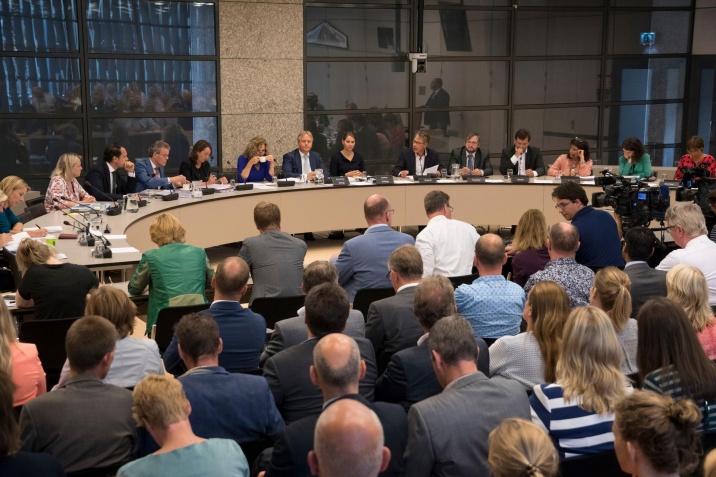
AMSTERDAM – The Dutch Animal Rights Party has renewed its struggle against ritual slaughter in the Netherlands. Days before Rosh Hashanah, the Jewish New Year, the Dutch parliament convened in a round table expert debate to discuss the Animal Rights Party’s latest proposal to ban ritual slaughter altogether.
The new proposal comes only a year and half after the implementation of the Ritual Slaughter Agreement. That agreement was the result of intense negotiation between the Jewish and Muslim communities on the one hand and the Dutch government on the other. Representatives of both communities agreed to implement all proposed veterinary and government recommendations to reduce animal suffering and improve the slaughtering process. Among others, the new regulations that have since been in place, require that animals which have not fully lost consciousness 40 seconds after their throats have been cut, are to be stunned, to stop any possible pain or suffering.
The new regulations came on top of existing strict rules, requiring, among others, 100 percent veterinary supervision with all ritual slaughter (as opposed to the regular slaughter industry, where systematic veterinary supervision does not take place).
The implementation of the Dutch Ritual Slaughter Agreement is due to be reviewed in 18 months time. However, the Animal Rights Party, who was also the party that back in 2012 had demanded stricter regulations and supervision on ritual slaughter (resulting in the Ritual Slaughter Agreement), decided that now was the time to request a full ban.
Late September, a hearing took place in the Dutch parliament, featuring not only representatives of the Jewish and Muslim communities in the Netherlands, but, surprisingly, also Princess Alia Bint Hussein, daughter of the late Jordanian King Hussein. The princess is mainly known for her involvement in horse sports and animal welfare. The Animal Rights Party had approached her to update the Dutch parliament via Skype about the Muslim law on pre-slaughter stunning.
Stunning and sedation are among the main bottlenecks in the public debate about ritual slaughter, both in Jewish and Muslim law. Kosher slaughter, or shechitah, involves using a sharp knife to cut open an animal’s trachea and esophagus in a motion quick enough to limit the animal’s pain and kill it immediately. Jewish law requires the animal to be fully conscious and able to stand on its own feet before the slaughter takes place. That is, among others, why in kosher slaughter, the animals cannot be sedated or stunned before they are killed.
In regular slaughter, sedating or stunning animals (both of which can be done in various ways) has been common practice since the early 20th century.
Most people advocating a ban on ritual slaughter, criticize the fact that animals are killed without prior sedation or stunning, and would therefore experience a cruel, slow and painful death.
So far, academic research, which has been presented at length by both sides of the decades-old heated debate, has not been able to establish which method is the least painful for the animal – with or without prior stunning or sedation. Nevertheless, more and more countries in Europe are moving towards tighter regulations for ritual slaughter.
As of November 2019, kosher slaughter has been highly regulated in the Netherlands, Germany, Poland, Latvia, Estonia, Lithuania, Finland, France and Spain. Belgium, Iceland, Spain and Switzerland have fully banned ritual slaughter.
The debate about ritual slaughter has increased ever since the European Union issued the European Convention for the Protection of Animals for Slaughter in 1998. The convention required stunning before all slaughter – except ritual slaughter. This moved several countries to issue a complete ban on meat originating from un-stunned slaughter. Several years later, in 2004, the European Food Safety Authority wrote that “due to the serious animal welfare concerns associated with slaughter without stunning, pre-cut stunning should always be performed.”
Five years later, in 2009, a complete ban on ritual slaughter without stunning was expected, but thwarted at the last minute, resulting in the EU Slaughter Regulation, permitting religious slaughter without stunning. However, ever since, individual countries have imposed tighter regulations on ritual slaughter, among which, the Netherlands.
At the round table discussion in The Hague, Jordanian Princess Alia Bint Hussein said that “Islam really focuses on the welfare of the animal and on reducing stress during slaughter and the lead-up to slaughter. […] Anything that can actually minimize its suffering is very important. In these days, when the numbers are so much greater, the time to be able to relax an animal is tighter. In my opinion and in the opinion of the authorities I have discussed this with, compulsory stunning would be a fantastic thing. It would insure that the animals actually die without experiencing pain. In my experience, some Islamic authorities have reservations because they actually do not know all the facts or are misled by people as to what happens. They feel that the animal does not bleed enough. That is not true. It is only when the animal has been stressed immensely beforehand that its veins are constricted.”
On behalf of the Jewish community, Ruben Vis, secretary of the Orthodox Jewish Union in the Netherlands, gave his view on the situation.

Ruben Vis, Secretary of the Dutch Jewish Orthodox Community, adressing the Parliamentary Committee at the round table debate
Vis referred to the fact that the Animal Rights Party’s proposal for a complete ban on ritual slaughter contained a great number of gross and factual mistakes. “In her proposal, MP Marianne Thieme claimed some 1.8 million animals were ritually slaughtered in the Netherlands, while the NVWA [RL, the Dutch equivalent of the FDA, responsible for supervising the food industry] reported a total of 68,000 animals, some 3,000 of which for the Dutch kosher market.” Both Vis and his colleague Michael Bloemendal, Executive Director of the Jewish Orthodox Union, referred to the fact the Animal Rights Party described mistakes and evils that supposedly came from the Jewish ritual slaughter situation, while they obviously were not.
Referring to the fact that Jewish ritual slaughter takes place on a very small scale, Bloemdal said “we, the Jewish Community, personally witness each and every animal being slaughtered. We always see the veteriniarian being present, and we know when the FDA is present. But we have never seen any investigator from the Animal Rights Party being present at one of our slaughter houses. Also, the situation and process described in the Animal Rights Party’s report, does not describe the way kosher slaughter is performed here in the Netherlands. The NVWA [=the Dutch equivalent of the FDA, RL] can confirm this.”
As the round table debate in parliament continued, Bloemendal and Vis referred to a whole list of mistakes and misrepresentations about Dutch ritual slaughter in the Animal Rights Party’s report on the subject.
At the same time, Bloemendal and Vis subtly hinted at the question whether stunning or sedating would indeed be guarantee for less animal suffering, particularly in today’s intensive bio-industry, which approached animals as products rather than living beings. “In the regular chicken slaughter industry,” Bloemendal said, “chickens are electrocuted prior to their slaughter using the same amount of electricity for all chickens. But chickens have different sizes, and different amounts of feathers. At least 20 percent of all chickens are not dead upon electrocution. They are subsequently fleeced and cut alive in machines.”
Wrongful industrial stunning of cows results in similar numbers of highly cruel deaths, Bloemendal told parliament, with cows being hung upside down at hooks before being slaughtered, being fully conscious. Without saying it explicitly, Bloemendal and Vis indicated that that stunning, sedating and electrocution posed great problems precisely for animal welfare, and, henceforth, Jewish law.
So far, there is no majority in the Dutch parliament to issue a full ban on ritual slaughter, but time will tell whether the Ritual Slaughter Agreement as it has been implemented, will remain in place, or will be tightened, once it is reviewed in 18 months time. The next parliamentary elections are due in 2021. Depending on the election success of the Animal Rights Party and the liberal left D’66 Party – both of which are expected to get more seats in parliament according to ongoing polls – the tide for ritual slaughter may always turn.
Table 1: Status quo on ritual slaughter in Europe
| Country | Status |
|---|---|
| Netherlands | Highly regulated slaughter permitted with permit. All slaughter occurs with 100 percent veterinary supervision. Post-stunning required when death has not established after 40 seconds. Exporting ritually slaughtered meat is prohibited. |
| Germany | Highly regulated ritual slaughter permitted with permit. |
| United Kingdom | Regulated ritual slaughter permitted, in a slaughterhouse approved by the Food Standards Agency. |
| Poland | Highly regulated ritual slaughter permitted. Several attempts to criminalize ritual slaughter, backlashed. |
| Lithuania | Highly regulated ritual slaughter permitted in government-licensed slaughterhouse. |
| Latvia | Highly regulated ritual slaughter permitted. Post-cut stunning required. |
| Estonia | It has the tightest regulations on ritual slaughter in Europe. Post-cut stunning required. |
| Finland | Simultaneous stunning required. A new Animal Welfare Act is prepared for 2020, most likely including a ban on ritual slaughter. |
| France | Highly regulated ritual slaughter permitted with prior government authorization. |
| Spain | Highly regulated ritual slaughter permitted with written request and veterinary supervision. |
| Sweden | Ritual slaughter banned: pre-cut stunning required |
| Norway | Ritual slaughter banned |
| Iceland | Ritual slaughter banned: sedation required |
| Belgium | Ritual slaughter banned: sedation required |
Published in Ami Magazine, November 8, 2019